The True Cost of an Off-Channel Communications Violation
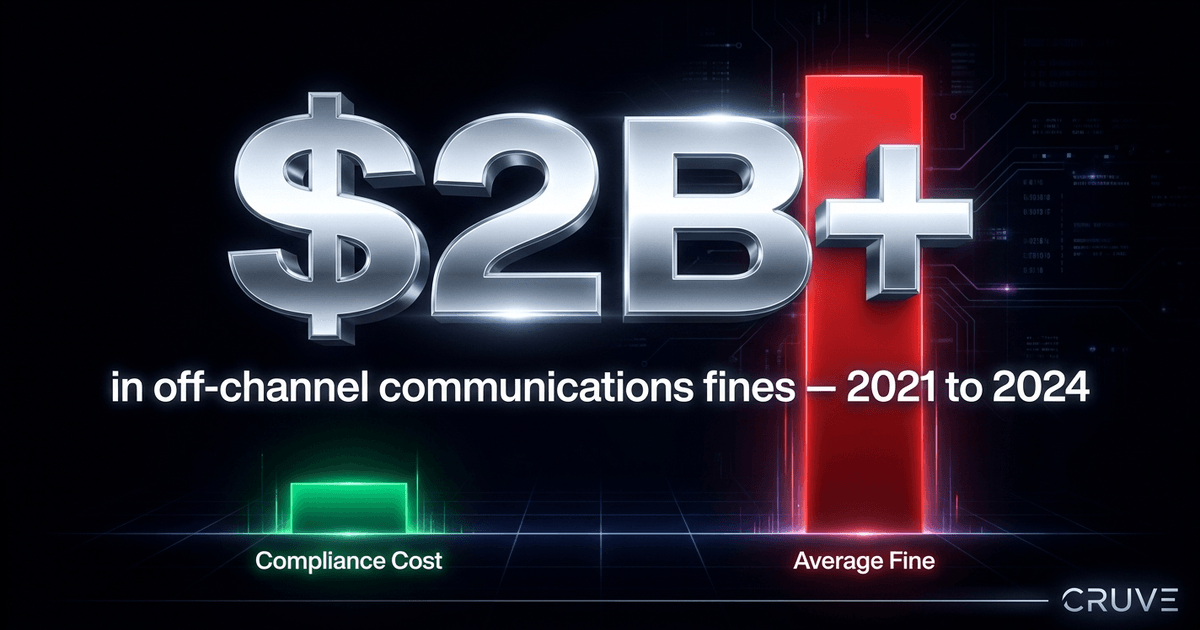
Since 2021, U.S. financial regulators have assessed over $2 billion in fines against broker-dealers and investment advisers for off-channel communications violations. The firms fined weren't small operations. They included some of the largest names in finance. And the fines weren't for fraud — they were for failing to preserve business communications conducted on personal devices and consumer messaging apps.
What the Numbers Actually Look Like
The SEC and FINRA have been remarkably systematic in their enforcement approach. The fines are calibrated to firm size, scale with the severity and duration of the violation, and reward early cooperation. The 2022 "off-channel" sweep resulted in fines against 16 broker-dealers totaling over $1.8 billion. Individual firms paid between $7.5 million and $200 million.
These numbers get attention. But they represent only the direct financial cost of the violations. The true cost is substantially higher.
The Direct Financial Cost
The fine itself is only one component of direct financial exposure:
Legal and regulatory counsel fees: Responding to requests, negotiating settlements, conducting internal investigations, and preparing remediation plans requires significant legal resources. For a multi-year enforcement action, these fees routinely exceed the fine amount.
Compliance remediation costs: Regulators don't just assess fines — they require remediation. Firms must demonstrate they've identified the root cause and implemented controls to prevent recurrence. This can require replacing messaging platforms, implementing new monitoring systems, retraining employees, and hiring additional compliance staff.
Disgorgement and restitution: When communications violations are connected to substantive misconduct, regulators can require disgorgement of profits and restitution to harmed clients — adding another dimension of financial exposure beyond the base fine.
The Indirect and Reputational Cost
Client attrition: Enforcement actions become public. Institutional clients with fiduciary obligations of their own review their counterparties' regulatory records. A significant enforcement action triggers client inquiries, RFP requirements, and in some cases, relationship termination.
Talent impact: Compliance and legal professionals are particularly sensitive to firms' regulatory records. Significant enforcement actions complicate recruiting and can trigger departures of compliance staff.
Regulatory relationship cost: After an enforcement action, firms operate under enhanced regulatory scrutiny. Future examination cycles are more intensive. The burden of demonstrating compliance with every requirement increases.
Management distraction: Senior management involvement in enforcement responses, board-level regulatory reporting, and the operational demands of remediation consume executive attention that would otherwise be focused on business development and strategy.
The Cost of the Violation vs. the Cost of the Solution
This is the arithmetic that compliance officers need to present to their business and technology leadership.
A purpose-built compliant messaging platform, properly deployed across a mid-size broker-dealer, costs on the order of $50,000 to $300,000 annually, depending on firm size and feature requirements. The total investment over three years — the minimum retention period under Rule 17a-4 — is in the range of $150,000 to $1,000,000 for most firms.
The median fine for off-channel communications violations in the 2022-2023 enforcement sweep was approximately $125 million. The smallest fine assessed was $7.5 million.
The compliance math is not close. The cost of a violation is orders of magnitude larger than the cost of a solution. The only scenario where deferring compliance investment makes economic sense is one where the probability of a violation is assumed to be near zero — and FINRA's current enforcement posture makes that assumption untenable.
Why Firms Still Get This Wrong
Employee behavior is genuinely difficult to control. Prohibition policies are insufficient when employees have personal devices in their pockets that are more convenient than approved platforms.
Approved platforms are often inadequate for actual communication needs. When firms deploy compliant messaging platforms that are cumbersome or missing features, employees route around them.
The regulatory risk feels remote until it isn't. Enforcement actions happen to other firms, until they happen to yours. The cognitive distance between "FINRA is fining someone" and "FINRA is examining us" is real, even when the underlying risk is identical.
The Proactive Alternative
The firms that emerge from the current enforcement environment in the strongest position are those that treat communications compliance as a business problem with a business solution, not as a regulatory irritant to be managed with policy and periodic training.
That means deploying communications infrastructure that employees will actually use — fast, mobile-native, feature-rich — that is also compliant by design. Not compliant through overlay products. Compliant at the architectural level, in a way that makes it impossible to have off-channel communications because the approved channel is the channel employees prefer.
READY TO BUILD A COMPLIANT COMMUNICATIONS PROGRAM?
Cruve is purpose-built for FINRA and SEC-regulated firms — E2EE, WORM archiving, and supervisory review in one platform.
Request Early Access